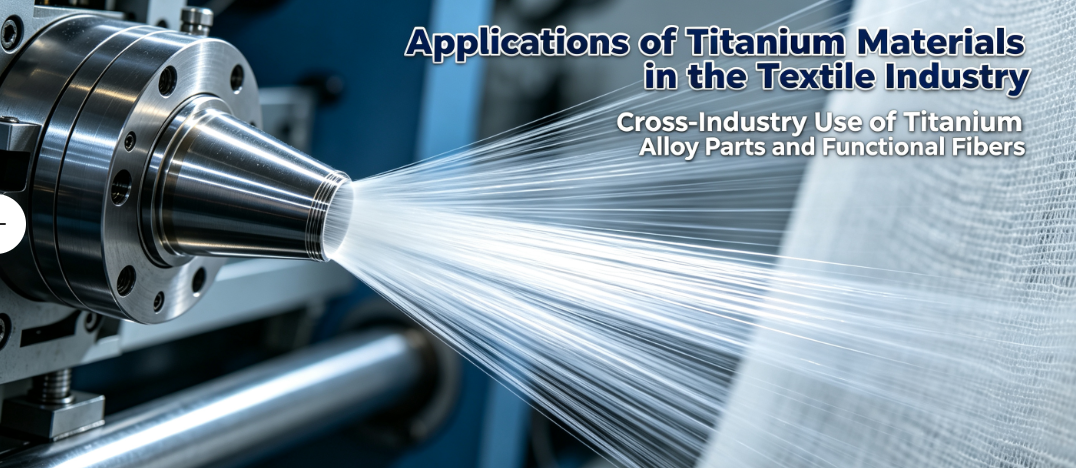
The textile industry relies heavily on durable production equipment and high-performance functional fabrics. Titanium materials, including pure titanium, titanium alloy parts and titanium dioxide powder, have become increasingly important in textile manufacturing. They are widely used in textile machinery, synthetic fiber production, fabric finishing, smart textiles and medical textile sectors.
1. Titanium Alloy Parts for Textile Production Machinery
Textile production environments often involve water, acid/alkali dye solutions, high humidity and continuous high-speed friction. Ordinary steel parts easily rust, corrode and wear out, causing frequent downtime. Titanium (TA1 / TA2 / TC4) components solve these pain points.
Dyeing & finishing equipment: Titanium rollers, spray nozzles, heating pipes and fixture clamps used in dye vats and washing machines. Titanium’s excellent corrosion resistance withstands acidic, alkaline dye liquor and hot water, extending service life and avoiding metal contamination that may stain fabrics.
Sewing and weaving spare parts: Titanium-coated or solid titanium shuttle cores, thread guides and needle components. Low thermal conductivity reduces heat buildup during high-speed sewing, preventing thread melting and breakage. Titanium hardware also resists abrasion for long continuous operation.
Filtration components: Titanium filter meshes used for filtering dye liquor and spinning melt. The rigid, corrosion-resistant mesh maintains stable filtration precision in harsh chemical environments.
2. Titanium Dioxide (TiO₂) as a Core Additive for Synthetic Fibers
Titanium dioxide is the most widely used titanium material in textile fiber production, added during melt spinning of polyester, nylon, polypropylene and viscose.
Delustering and opacity control: Without TiO₂, synthetic fibers appear shiny and translucent. Anatase titanium dioxide scatters light to create semi-dull or full-dull matte fibers, achieving the natural soft look of cotton fabrics.
UV protection: TiO₂ particles absorb and scatter UVA and UVB radiation. Fibers blended with TiO₂ produce high UPF outdoor fabrics, protecting both human skin and polymer fibers from photo-degradation and fading.
Whiteness and dye uniformity: It stabilizes fiber whiteness and improves dye uptake consistency, reducing color variation in finished textile rolls.
3. Functional Finishes: Antibacterial, Self-cleaning Titanium-treated Fabrics
Nano titanium dioxide can be coated onto fabric surfaces to create functional textiles with photocatalytic properties.
When exposed to light, nano TiO₂ generates reactive oxygen radicals that break down organic matter, bacteria and odor-causing compounds.
Antibacterial & deodorant sportswear: Inhibits staphylococcus and E. coli, reduces sweat odor and maintains hygiene after repeated washing.
Self-cleaning outdoor textiles: Sunlight triggers photocatalysis to decompose oil stains and dirt, suitable for awnings, outdoor tents and upholstery fabrics.
Medical textiles: Hygienic titanium-modified nonwovens and medical dressings reduce bacterial proliferation.
4. Ultra-fine Titanium Filaments for Smart & Special Technical Textiles
Ultra-thin titanium wire can be knitted or braided into flexible metal textile structures.
Smart wearable textiles: Titanium conductive filaments embedded into fabrics to make flexible temperature, pressure and heart rate sensors for wearable health monitoring clothing.
High strength protective textiles: Titanium mesh fabrics with lightweight, high tensile strength, used for heat-resistant and radiation shielding industrial textiles.
Biocompatible medical mesh: Braided titanium textile scaffolds for biomedical applications, thanks to titanium’s outstanding biocompatibility.
Limitations of Titanium Materials in Textile Industry
High cost: Titanium alloy machinery parts and fine titanium filaments carry much higher raw material and processing cost than steel. TiO₂ also increases fiber production expenses.
Dispersion challenge: Poor dispersion of nano TiO₂ inside fiber melt will cause spinneret clogging and fiber breakage during spinning.
Photocatalysis conditions: The antibacterial and self-cleaning performance of TiO₂ coating requires light activation; its effect is weak in dark environments.
Conclusion
Titanium materials support the textile industry from two directions: corrosion-resistant titanium hardware for textile production equipment, and titanium dioxide functional additives to upgrade fiber and fabric performance. As demand for UV-protective, antibacterial, self-cleaning and smart textiles keeps growing, titanium-based textile solutions will expand further in outdoor apparel, medical textiles and industrial technical fabrics.
Technical Guide5 min read·2026-09-23
Applications of Titanium Materials in the Textile Industry
Titanium materials serve the textile industry in two major forms: solid titanium alloy components for textile machinery and titanium-based functional additives (mainly titanium dioxide) for fiber and fabric production. This guide explains the wide use of titanium in spinning, weaving, dyeing-finishing and functional textile manufacturing, covering corrosion resistance, UV shielding, antibacterial and self-cleaning benefits.