Introduction
Medical titanium alloys have long been the preferred material for surgical implants, medical instruments, and wearable medical devices due to their superior biocompatibility, stable chemical properties, excellent mechanical strength, and outstanding corrosion resistance. Compared with ordinary structural parts, titanium components used in the medical industry feature ultra-tight dimensional tolerances, high surface finish standards and strict biological safety regulations. Even subtle machining deviations may lead to assembly failure, reduced service life, or potential safety risks for end patients.
Among all manufacturing difficulties, achieving extreme tight tolerance on titanium alloy remains the biggest bottleneck for precision medical component manufacturing. Titanium’s inherent material characteristics such as low thermal conductivity, high work-hardening tendency and high cutting force frequently cause thermal deformation, tool abrasion and unstable dimensional accuracy during processing. In this article, CNBJTI shares our complete technical solution for manufacturing custom medical titanium parts with a tolerance of ±0.005 mm, covering material selection, optimized machining strategies, deformation control and standardized quality inspection.
Material Selection for Medical-Grade Titanium Alloy
Material selection serves as the foundation of high-precision medical component manufacturing. For implant-grade and high-precision medical devices, we adopted Ti-6Al-4V ELI, also known as Grade 5 ELI titanium alloy, which is widely recognized in the global medical industry and fully compliant with ASTM F136 specifications.
Different from standard Ti-6Al-4V titanium, the ELI version strictly controls interstitial elements including oxygen, carbon and nitrogen. Lower impurity content effectively reduces the risk of tissue rejection and allergic reactions after long-term implantation inside the human body. Meanwhile, this material maintains balanced ductility and fatigue resistance, which perfectly adapts to complex working environments such as repeated friction and physiological load inside human bodies.
Before formal production, our team completed comprehensive raw material verification, including chemical composition detection, mechanical performance testing and full batch traceability filing. All material test reports are archived to satisfy ISO 13485 medical quality management requirements and meet third-party audit standards for medical devices.
Core Challenges of Precision Titanium Machining
Machining medical titanium components with ±0.005 mm extreme tolerance is far more difficult than producing conventional mechanical parts. Combined with our practical production experience, the core challenges are summarized into three major aspects.
First, thermal deformation. Titanium alloy only possesses one-fifth the thermal conductivity of stainless steel. Most cutting heat accumulates on the cutting edge and workpiece surface instead of dissipating rapidly. Local overheating easily causes irreversible thermal expansion and micro-deformation, directly affecting final dimensional accuracy.
Second, severe work hardening. The cutting process will generate hardened layers on the component surface. Excessive hardening not only damages surface integrity but also aggravates tool wear, resulting in inconsistent sizes in mass production.
Third, complex structural tolerance coupling. Most medical parts feature irregular curved surfaces, deep grooves and micro-hole structures. Position tolerance, profile tolerance and flatness restrict each other, making it difficult to stabilize overall precision through traditional 3-axis machining.
Optimized Machining Process for Extreme Tolerance Control
Pre-Machining Stress Relief and Fixture Customization
To eliminate hidden deformation risks in advance, we added a dedicated stress relief procedure for raw materials. After rough forging, the titanium blank undergoes segmented constant-temperature heat treatment to eliminate residual internal stress generated during forging. This step effectively avoids slow dimensional drift after finished parts are delivered to customers.
In terms of clamping, we designed an integrated customized fixture according to the component’s structural characteristics. The optimized contact area and clamping force distribution reduce vibration during high-speed cutting. Stable clamping conditions greatly improve the repeat positioning accuracy of workpieces during multi-process switching.
5-Axis CNC Machining & Cryogenic Auxiliary Processing
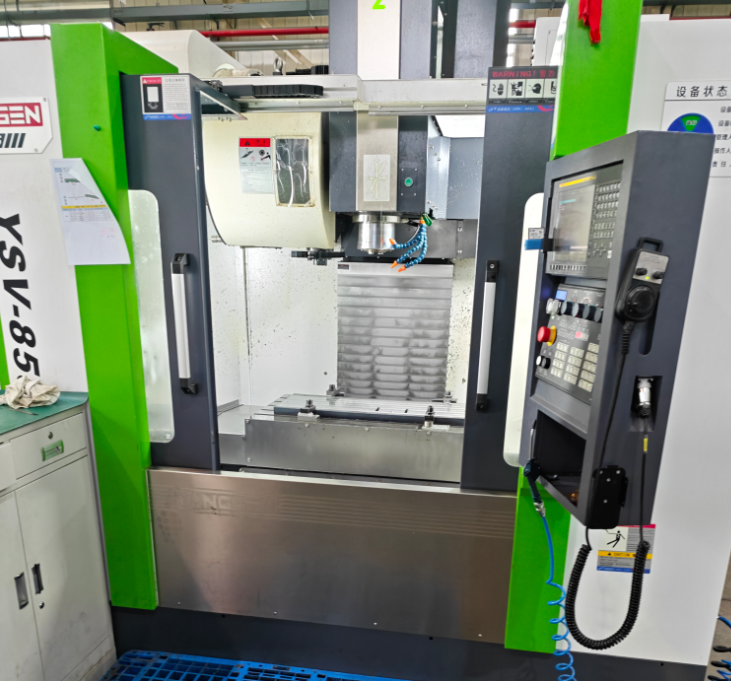
We adopted high-precision 5-axis CNC machining equipment to complete integrated forming of complex medical titanium parts. Compared with traditional processing methods, 5-axis linkage machining realizes one-time clamping and multi-angle forming, minimizing dimensional errors caused by repeated positioning and replacing multiple fixtures.
To solve the thermal deformation problem of titanium alloy, we introduced cryogenic machining technology. Liquid nitrogen is used to continuously cool the cutting area during finishing, which instantly takes away cutting heat, inhibits surface work hardening and significantly reduces thermal expansion of workpieces. Cooperated with low-depth and high-feed finishing parameters, this processing method effectively protects micro-features such as tiny grooves and thin walls, steadily supporting the tolerance requirement of ±0.005 mm.
Post-Processing Surface Treatment
After finishing all mechanical processing, all medical titanium components undergo professional passivation treatment. We use nitric acid solution to remove surface metal debris, cutting oil residues and free iron impurities produced during machining. The passivated titanium surface forms a dense protective oxide film, further improving biocompatibility and corrosion resistance to meet medical-grade surface cleanliness standards.
Quality Inspection & Medical Standard Compliance
High-precision production requires matching rigorous inspection systems. All critical dimensions and geometric tolerances of finished medical titanium parts are detected by high-precision coordinate measuring machines (CMM). Our inspection items cover overall dimensional accuracy, profile tolerance, verticality, concentricity and surface roughness. The surface roughness of finished products is controlled below Ra 0.4μm to satisfy assembly and medical application demands.
In terms of quality management, the entire production process fully complies with the ISO 13485 medical device quality system. We provide complete supporting documents for every batch of products, including raw material MTR certificates, first article inspection reports, process inspection records and final dimensional detection reports. For special implant scenarios, we also support third-party biocompatibility testing and non-destructive flaw detection services.
Practical Experience & Key Takeaways
Based on this high-precision medical titanium component project, we concluded that stable extreme-tolerance manufacturing is a systematic project instead of relying solely on high-end equipment. Qualified medical titanium parts require scientific material screening, reasonable stress relief strategies, optimized cutting parameters and full-process closed-loop quality inspection.
For buyers and designers in the medical industry, clearly defining tolerance priority, surface finish requirements and certification standards in the early design stage can effectively shorten the manufacturing cycle and reduce unnecessary processing costs. Choosing a manufacturer with mature medical titanium processing experience can greatly lower the risk of dimensional failure and non-compliance.
Conclusion
Manufacturing medical titanium components with ±0.005mm extreme tolerance is still a challenging task in the precision manufacturing industry. By selecting Ti-6Al-4V ELI implant-grade titanium alloy, combining stress relief treatment, customized fixture clamping, 5-axis precision machining and cryogenic cooling technology, CNBJTI successfully solves common problems such as thermal deformation, tool wear and unstable size during titanium processing.
As medical device standards become increasingly stringent worldwide, high-precision and high-biocompatibility titanium processing will become the core competitiveness of medical component suppliers. CNBJTI has accumulated mature manufacturing experience in implant parts, surgical tool accessories and customized medical titanium structural parts. We support one-stop services including material customization, precision machining, surface treatment and full-standard compliance certification to meet diversified customized demands from global medical industry clients.
If you have any inquiries about medical titanium material selection, tolerance feasibility evaluation or customized precision machining, feel free to contact our engineering team for professional technical support and tailored quotation.
FAQ6 min read·2026-05-28
How We Machined a Medical Titanium Component to Meet ±0.005mm Extreme Tolerance Requirements
A practical guide from CNBJTI on machining medical titanium components to meet ±0.005mm extreme tolerance requirements. Learn about grade selection, precision processing, ISO 13485 certification, and RFQ tips for medical titanium parts.