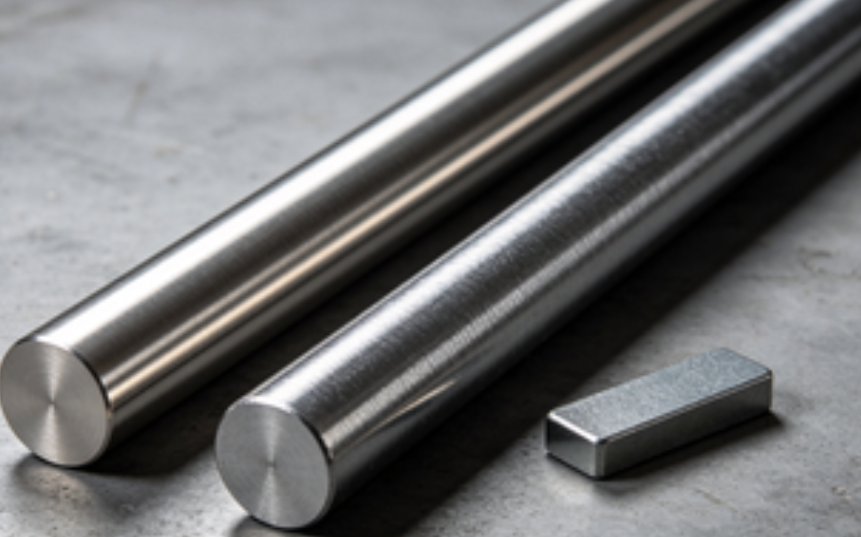
A practical, buyer-focused comparison of tungsten and titanium, clarifying which material is stronger, and which is better for your application.
1. Core Answer: Is Tungsten Stronger?
Yes, tungsten is generally stronger than titanium in terms of hardness, tensile strength, and wear resistance—but the comparison is not one-size-fits-all. The key lies in how you define “strength” for your specific use case.
2. How Their Strength Profiles Compare
When evaluating strength, it’s critical to distinguish between different types of performance:
Hardness and wear resistance: Tungsten is significantly harder than titanium, making it far more resistant to scratches, abrasion, and deformation under contact stress. This makes it ideal for cutting tools, industrial dies, and parts exposed to extreme wear.
Tensile strength: In pure form, tungsten’s tensile strength is lower than common high-strength titanium alloys like Grade 5. Alloyed titanium can deliver exceptional tensile strength while weighing only about a quarter of tungsten’s mass.
High-temperature performance: Tungsten’s melting point is more than twice that of titanium, giving it unmatched stability in extreme heat environments where titanium would soften or oxidize.
3. Key Trade-Offs Beyond Strength
While tungsten excels in hardness and heat resistance, it has notable drawbacks compared to titanium:
Weight: Tungsten is over four times denser than titanium. This makes it impractical for applications where low weight is critical, such as aerospace, medical implants, or portable equipment.
Corrosion resistance: Titanium forms a protective oxide layer that resists corrosion in saltwater, acids, and many industrial environments. Tungsten, while durable, is more prone to oxidation and chemical attack at high temperatures or in certain corrosive conditions.
Biocompatibility: Titanium is widely used in medical implants because it is non-toxic, non-allergenic, and compatible with human tissue. Tungsten is not suitable for most medical implant applications.
4. Which One Should You Choose?
Your choice depends entirely on your application priorities:
Choose tungsten if your top needs are extreme hardness, wear resistance, high-temperature stability, or high density (e.g., counterweights, radiation shielding).
Choose titanium if you need a high strength-to-weight ratio, excellent corrosion resistance, biocompatibility, or low weight (e.g., aerospace components, marine equipment, medical implants).
5. Sourcing & Specification Tips
When comparing these materials for your RFQ, keep these points in mind:
Be specific about the grade: For titanium, confirm if you need commercially pure titanium or a high-strength alloy like Grade 5. For tungsten, clarify if you’re specifying pure tungsten or tungsten carbide (a common, even harder composite).
Focus on the performance metrics that matter most to your design, not just generic “strength.” For example, if weight is a constraint, titanium’s strength-to-weight ratio will outperform tungsten by a wide margin.
Consider total lifecycle costs: Titanium’s higher upfront cost is often offset by its light weight, corrosion resistance, and long service life, especially in harsh environments.
Material Comparison4 min read·2026-05-23
Is Tungsten Stronger Than Titanium?
A buyer-friendly comparison of tungsten vs titanium, covering strength trade-offs, density, cost factors, and key specification checks for industrial and sourcing decisions.