Introduction
Chemical manufacturing runs around corrosive raw materials, fluctuating working temperatures and long-cycle continuous production, which puts extremely strict requirements on pipeline, heat exchanger and reactor materials. Conventional carbon steel and regular stainless steel struggle to stand long-term erosion from acid, alkali and brine medium, bringing frequent equipment leakage, unplanned shutdown and high annual maintenance cost for chemical enterprises.
As global chemical industry upgrades production standards and pursues lower full-lifecycle operating expenditure, titanium gradually becomes an irreplaceable core structural material across fine chemical, petrochemical, salt chemical and chlor-alkali chemical fields. Relying on unique natural anti-corrosion property, stable mechanical performance and long service lifespan, titanium tubing and vessel components solve many long-standing pain points that traditional metal materials cannot overcome. This article focuses on titanium’s core advantages in chemical scenarios, practical material selection rules, fabrication specifications and complete documentation guidance for industrial buyers.
1. Why Titanium Is Indispensable for Chemical Production Equipment
1.1 Incomparable Natural Corrosion Resistance
The core advantage that makes titanium dominate corrosive chemical environments lies in its spontaneous self-repairing TiO₂ passive film on surface. Once contacting oxygen or moisture, compact oxide layer forms instantly, and it will regenerate rapidly after scratch or mechanical abrasion to block further medium penetration.
In working conditions filled with hydrochloric acid, sulfuric acid, chloride brine and mixed alkaline solution, ordinary steel corrodes and thins rapidly within several years even after anti-rust coating treatment, while titanium piping and liner can keep intact for over 20 years without extra surface protection. For chemical workshops with alternating dry-wet and high-salt vapor, this property largely cuts regular repair and component replacement expense.
1.2 Stable Performance Under Wide Temperature Range
Chemical production often involves low-temperature refrigeration reaction and medium-high temperature distillation process, requiring equipment to maintain stable mechanical property under variable thermal environment. Titanium keeps consistent tensile strength and toughness from cryogenic minus 196℃ up to nearly 550℃, free from cold brittleness or high-temperature creep deformation that troubles carbon steel.
Whether used for low-temperature cooling circulating pipeline or high-temperature reaction kettle lining, titanium avoids hidden safety hazard caused by material performance degradation under extreme temperature shift.
1.3 Outstanding Anti-Fatigue for Continuous Operation
Most chemical devices run nonstop all year round, enduring cyclic medium pressure and slight mechanical vibration day and night. Common steel is prone to tiny fatigue crack after long-term alternating load, which expands gradually and triggers pipeline rupture or container leakage.
Titanium’s compact crystal structure delivers excellent anti-fatigue characteristic, adapting well to long-period uninterrupted production of chemical factories and lowering unexpected breakdown risk effectively.
2. Core Chemical Industry Application Scenarios of Titanium Products
2.1 Heat Exchanger Tubing System
Titanium seamless tube is the mainstream choice for chemical heat exchange equipment, widely installed in cooling and heating loops of petrochemical, desalination and fine chemical projects. When heat exchanging between corrosive process liquid and cooling water, titanium tubing resists dual-side corrosion from process medium and salt-containing cooling water, securing stable heat transfer efficiency for decades without scaling or perforation.
2.2 Chemical Process Piping & Valve Components
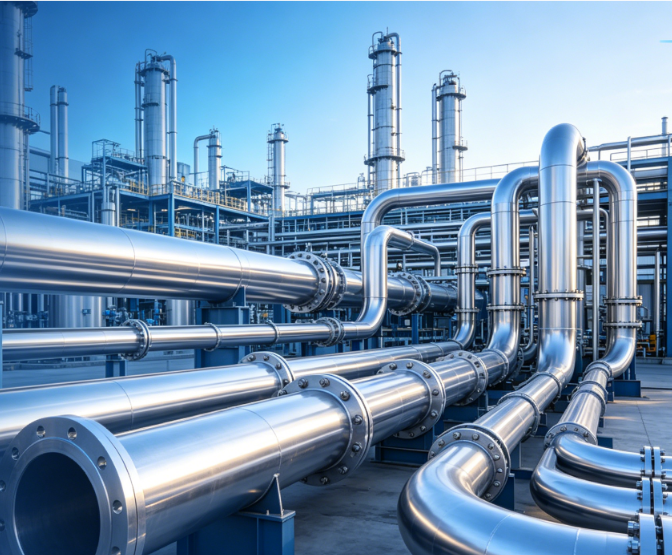
From raw material delivery pipeline to finished product output piping, titanium pipes replace stainless steel in most high-corrosion production lines. Supporting titanium-made valve body and connecting fittings match whole pipeline system, eliminating the leakage risk caused by different material corrosion difference at joint positions. Chlor-alkali and brine chemical factories are the biggest end-users of industrial titanium piping.
2.3 Reactor Inner Lining & Storage Tank Accessories
Instead of integral expensive titanium container, most chemical plants adopt titanium sheet lining for carbon steel reaction tank and storage vessel. This solution combines steel’s low structural cost and titanium’s corrosion resistance, effectively preventing corrosive medium from eroding outer steel shell and cutting overall equipment investment while guaranteeing safety.
2.4 Desalination & Wastewater Treatment Chemical Units
Industrial desalination and chemical wastewater disposal contain high-concentration chloride and residual acid, which rapidly destroy regular metal equipment. Titanium piping and filter components become standard configuration for these projects to extend system service cycle.
3. Practical Titanium Grade Selection Guide for Chemical Buyers
Commercially pure titanium Grade 2 takes up over 80% of chemical industry consumption, balancing favorable corrosion resistance and reasonable raw material cost, perfectly matching most brine, weak acid and neutral corrosive environment for heat exchanger tubes and regular process pipes.
Grade7 titanium with trace palladium additive is customized for strong reducing acid environment such as concentrated hydrochloric acid, applied in special fine chemical workshops where Grade2 titanium cannot satisfy anti-corrosion requirement.
Grade5 high-strength titanium alloy is seldom used for full pipeline, mainly made into high-pressure valve core and heavy-load connecting fittings for high-pressure chemical reaction devices due to its superior tensile strength.
4. Key Fabrication & Quality Documentation Standards for Chemical-Grade Titanium
4.1 Professional Fabrication Requirements
Titanium is highly active under high temperature, so all welding construction for chemical piping must proceed under pure argon inert gas shielding to avoid oxygen and hydrogen pollution which will lead to brittle weld joints. Mechanical machining needs special sharp cutting tools and controlled cutting speed to prevent local overheating damage to material surface passive film.
4.2 Necessary Certification Documents for Order
Formal chemical-grade titanium procurement needs complete supporting documents complying with ASTM industry standards: full Material Test Report covering chemical composition and mechanical parameter, welding procedure certification files, NDT non-destructive inspection report including ultrasonic and radiographic test, and targeted anti-corrosion test data for special customized components. These files are essential for factory safety inspection and later equipment maintenance traceability.
5. Upfront Cost VS Long-Term Comprehensive Benefit
Many chemical purchasers hesitate to select titanium for its higher initial purchase price compared with stainless steel. But from full lifecycle cost accounting, titanium brings obvious economic advantage.
Though titanium pipe costs 3~4 times higher than regular stainless steel at purchase stage, its 20+ year service life skips frequent coating maintenance, annual inspection and repeated replacement work of steel equipment. Most chemical enterprises can recover extra initial investment within 3~5 years via saved maintenance and shutdown loss, gaining stable long-term production benefit.
Conclusion
Steel and stainless steel still occupy dominant position in mild-corrosion ordinary chemical workshops, yet in harsh medium working conditions with acid, alkali and high chloride content, no alternative metal can replace titanium’s comprehensive performance.
With stricter global environmental protection and production safety codes, more chemical project designers prefer titanium to upgrade core production equipment. Correct grade selection, standardized fabrication and complete certification management help buyers maximize titanium’s value and reduce long-term operational risk of chemical production lines.
Applications5 min read·2026-06-02
The Irreplaceability of Titanium in the Chemical Industry
How projects using titanium tubes and piping materials fit real industrial applications, with notes on material selection, corrosion resistance, fabrication and documentation for chemical industry buyers.