Introduction
The chemical industry demands materials that can withstand aggressive environments, high temperatures, and continuous exposure to corrosive fluids. Titanium has become one of the most reliable choices for this sector, thanks to its natural corrosion resistance, high strength-to-weight ratio, and long-term structural stability.
From reactors and heat exchangers to pipelines and storage tanks, titanium helps chemical plants maintain safety, efficiency, and durability under demanding operating conditions.
1. Why Titanium Is Important in the Chemical Industry
Chemical processing often involves acids, alkalis, salts, organic solvents, and high-temperature fluids. Ordinary carbon steel and even some stainless steels may degrade over time, leading to maintenance problems, safety risks, and higher operating costs.
Titanium addresses these challenges through several key properties:
Excellent corrosion resistance: Titanium forms a stable oxide layer that protects the material from oxidation and chemical attack.
High strength-to-weight ratio: Titanium provides strong mechanical performance without the excessive weight of many traditional metals.
Temperature stability: It maintains structural integrity in both high-temperature and low-temperature process conditions.
Long service life: Titanium equipment can reduce replacement frequency and lower long-term maintenance costs.
Compatibility with aggressive media: It performs well in environments where many other materials would fail.
2. Corrosion Resistance in Chemical Environments
One of the most important reasons titanium is used in the chemical industry is its resistance to corrosion. When titanium is exposed to oxygen, water, or many chemical media, it forms a thin but protective titanium dioxide layer on the surface.
This layer helps prevent further corrosion and can even self-repair if damaged. For chemical plants handling chlorides, salt solutions, organic acids, and certain corrosive gases, this property is extremely valuable.
However, titanium is not suitable for every chemical environment. In highly reducing conditions or in the presence of certain strong acids without proper protection, titanium may still experience corrosion. Therefore, material selection should always be based on specific process conditions, temperature, pressure, and medium composition.
3. Key Applications of Titanium in the Chemical Industry
Reactors
Chemical reactors require materials that can handle high pressure, high temperature, and corrosive reaction media. Titanium reactors are used in processes involving chlor-alkali production, organic synthesis, and various chemical reactions where corrosion resistance is critical.
Heat Exchangers
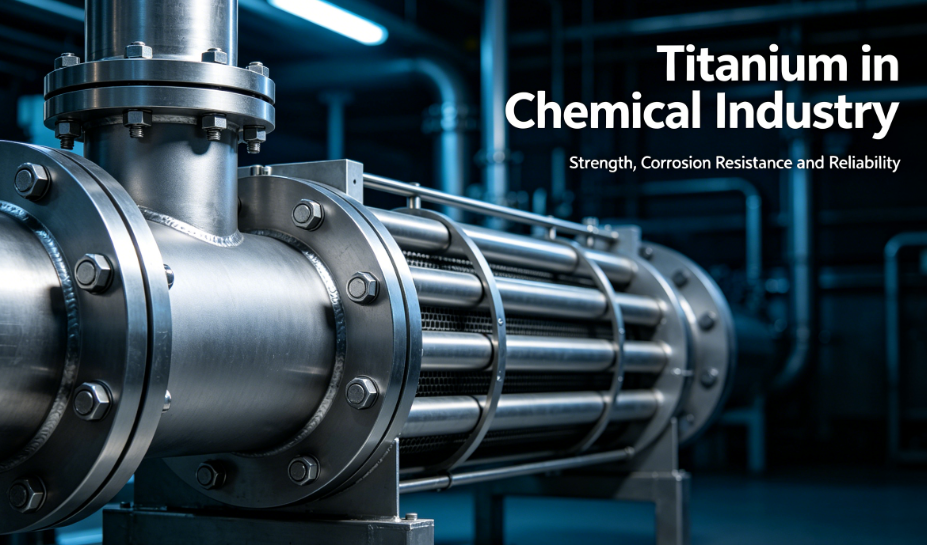
Titanium heat exchangers are widely used in chemical processing because they transfer heat efficiently while resisting corrosion. They are suitable for applications involving saltwater, acids, and other aggressive cooling or heating media.
Pipelines
Titanium pipelines are used to transport corrosive chemicals, brines, and process fluids. Their lightweight and high strength make them easier to install and support in complex plant layouts.
Storage Tanks
Titanium storage tanks are used for storing corrosive liquids, chemical intermediates, and finished products. They help reduce the risk of contamination and extend the service life of storage systems.
Valves and Fittings
In chemical plants, valves, flanges, and fittings must withstand constant exposure to aggressive media. Titanium components offer reliable performance in critical flow control points.
Evaporation and Crystallization Equipment
Processes such as evaporation, crystallization, and concentration often involve high temperatures and corrosive residues. Titanium equipment helps maintain performance and reduces the risk of material failure.
4. Titanium Grades for Chemical Processing
Commercially Pure Titanium
Commercially pure titanium, such as Grade 1 and Grade 2, is often used in chemical applications where excellent corrosion resistance is the main priority. It is suitable for tanks, heat exchangers, and piping systems operating in moderately aggressive environments.
Titanium Alloys
Titanium alloys offer higher strength and better performance under demanding mechanical loads. They are used in high-pressure reactors, high-temperature equipment, and components that require both strength and corrosion resistance.
ASTM Standards
Common standards for chemical industry titanium equipment include ASTM B265 for titanium sheet and strip, ASTM B338 for welded titanium tubes, and ASTM B861 for titanium pipe. These standards help ensure consistent material quality, mechanical properties, and corrosion performance.
5. Buying and Specifying Considerations
Understand the process medium: Confirm whether the equipment will be exposed to acids, alkalis, salts, organic solvents, or corrosive gases.
Check temperature and pressure: Titanium performance can change under extreme temperature and pressure conditions.
Select the correct titanium grade: Choose commercially pure titanium or titanium alloy based on strength and corrosion requirements.
Verify manufacturing standards: Look for relevant ASTM standards, material test reports, and certificates.
Consider fabrication quality: Welding, forming, and surface treatment affect the final performance of titanium equipment.
Plan for maintenance: Although titanium is low-maintenance, proper inspection and cleaning can extend service life.
Conclusion
Titanium plays a vital role in the chemical industry, especially in applications where corrosion resistance, strength, and long-term reliability are essential. Its ability to handle aggressive media, high temperatures, and challenging process conditions makes it a preferred material for reactors, heat exchangers, pipelines, storage tanks, and valves.
When selecting titanium equipment for chemical processing, it is important to consider the process environment, material grade, manufacturing standards, and maintenance requirements. With proper specification, titanium can help chemical plants improve safety, reduce downtime, and lower long-term operating costs.
Technical Guide5 min read·2026-06-16
Titanium in Chemical Industry: Corrosion Resistance, Applications and Buying Guide
Titanium plays a critical role in the chemical industry, offering excellent corrosion resistance, high strength, and long-term reliability for reactors, heat exchangers, pipelines, and storage tanks.