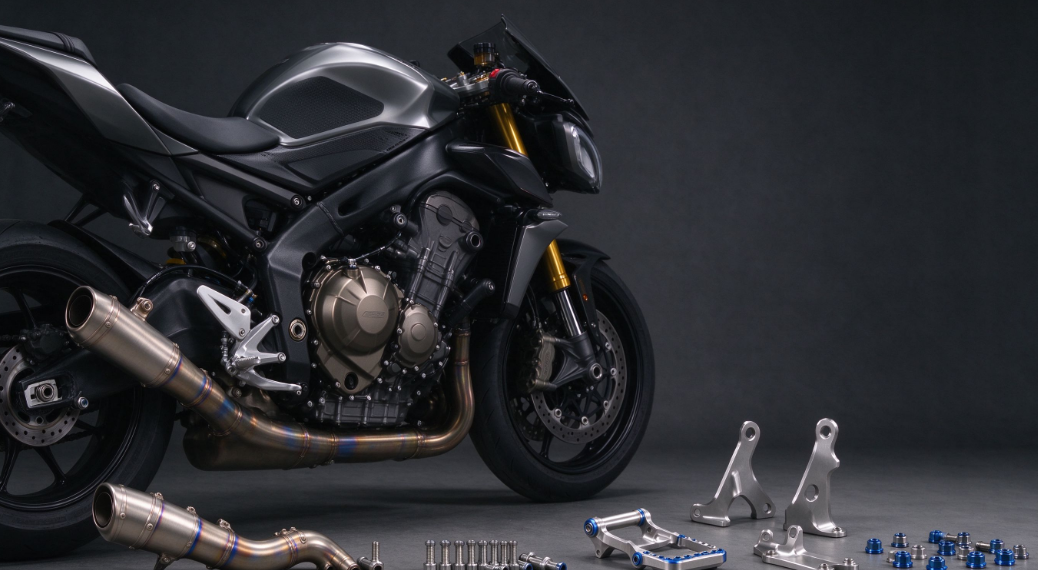
Titanium has moved from aerospace and Formula 1 racing into the motorcycle garage, and for good reason. It is light, strong, naturally corrosion-resistant, heat-tolerant, and it carries a distinctive finish that sets a custom build apart. If you are planning a cafe racer, scrambler, sport bike, off-road machine, or track project, one of the most common questions is simple: what can titanium be used for in motorcycle customization?
This guide walks through every category of titanium aftermarket and custom-made motorcycle part, from the exhaust system down to the smallest bolt, explains which titanium grade suits each component, and covers the practical limits and build checks that keep a titanium project safe, legal, and cost-effective.
Why Builders Choose Titanium for a Custom Motorcycle
Before listing the parts, it helps to understand the material advantages that drive a titanium build:
Weight reduction: Titanium's density is about 4.43–4.51 g/cm³, versus roughly 7.85 g/cm³ for steel, so titanium components are commonly around 40–45% lighter than steel equivalents.
High strength-to-weight ratio: Grade 5 titanium (Ti-6Al-4V) reaches tensile strengths around 900–1,100 MPa while staying far lighter than comparable steel.
Natural corrosion resistance: Titanium forms a self-healing TiO₂ oxide film that resists rain, coastal salt spray, road salt, and humid storage, so it does not rust like plated steel.
Heat resistance: Titanium retains useful strength at the elevated temperatures found near engines and exhausts.
Premium appearance: The natural silver-gray finish, and the blue, gold, or bronze coloring that appears after heating, gives titanium builds a race-inspired look.
These benefits do not mean every part should be titanium. The best custom builds match the material to the function, weight target, and budget of each location.
1. Exhaust Systems — the Most Popular Titanium Upgrade
The exhaust is the number-one titanium application in motorcycle customization. Builders replace the header pipes, collector, link pipe, mid-pipe, silencer can, and exhaust brackets with titanium because the system sits in a hot, exposed, vibration-heavy environment where titanium performs especially well.
What titanium exhaust parts include:
Header pipes and front pipes
Collector and mid/link pipes
Silencer and muffler outer shells
Exhaust flanges, hangers, and mounting brackets
Why titanium works here:
It cuts significant weight from the rear and front of the bike, improving mass distribution and handling.
It withstands sustained exhaust heat better than many ordinary steel and thin-walled alloys.
It resists rust, discoloration from moisture, and corrosion from road salt.
Welded titanium develops the characteristic heat-tinted blue, purple, or gold finish that many builders seek as a styling signature.
Pure commercially pure titanium (Grade 1 or Grade 2) and near-alpha alloy tubing such as Grade 9 (Ti-3Al-2.5V) are commonly used for exhaust tubes, where ductility, weldability, and thermal performance matter more than maximum tensile strength. Loaded flanges and brackets may be machined from Grade 5.
One practical note: aftermarket exhausts must comply with local noise and emissions regulations, and many regions require approved or certified systems for road use.
2. Complete Fastener Kits — Bolts, Nuts, and Spacers
A full titanium fastener kit is the most accessible entry point into a titanium build. It replaces the stock steel screws, flange bolts, nuts, washers, spacers, and standoffs across the fairing, bodywork, engine covers, and accessory mounts.
Typical fastener locations:
Fairing and bodywork bolts
Engine cover and casing screws
Subframe and panel fasteners
Brake caliper and lever mounting bolts
Footrest hanger and bracket bolts
Custom accessory and bracket spacers
Grade 5 Ti-6Al-4V is the standard alloy here because it combines high strength with the light weight needed for loaded bolted joints. A complete kit can remove several hundred grams to more than a kilogram of mass, while eliminating rust stains and seized steel screws.
Because titanium threads can gall and cold-weld during installation, fasteners should be fitted with a suitable anti-seize compound and tightened to titanium-specific torque values rather than stock steel figures.
3. Footpegs, Levers, and Rider Controls
Titanium CNC-machined controls are a popular upgrade on sport bikes, adventure bikes, and off-road machines where rider contact points take repeated load and abuse.
Common titanium control parts:
Footpegs and footrest platforms
Footrest hanger brackets and mounts
Gear shift lever and linkage
Rear brake pedal and lever
Clutch and brake lever adjusters
Handlebar bar ends and grip weights
Brake and shift linkage rods
Grade 5 titanium machined from solid bar stock provides the strength needed for rider load while reducing unsprung and sprung weight. On off-road and trial bikes, titanium footpegs resist bending, corrosion, and impact better than many standard components, and stay clean in wet, muddy, salt-exposed conditions.
4. Frame, Subframe, Swingarm, and Linkage Components
For advanced custom and race builds, titanium moves into the structural chassis. These are higher-investment parts that require engineering validation, but they are a proven titanium application in racing and specialized custom construction.
Possible titanium chassis components:
Subframe and rear frame sections
Swingarm or swingarm sections
Suspension linkage and dogbone brackets
Frame gussets, braces, and mounting plates
Steering and pivot reinforcement parts
Grade 5 and specialized titanium alloys are chosen here for their strength-to-weight ratio and fatigue resistance under repeated suspension and cornering loads. Structural chassis work should be designed, manufactured, and validated by experienced engineers; titanium must not be substituted into a load-bearing frame or swingarm without proper stress analysis, material certification, and welding qualification.
5. Wheels, Brake, and Drivetrain Hardware
At the performance end of the market, titanium also appears in wheel, brake, and chain-sprocket systems, where every gram of unsprung mass affects suspension response.
Examples include:
Titanium wheel hub bolts and spacers
Brake disc mounting bolts and carrier hardware
Sprocket mounting bolts and nuts
Chain and sprocket lightweight fasteners
Brake caliper and disc adapter fasteners
These parts are typically Grade 5, precision-machined to tight tolerances, and selected for high-performance or track applications. Brake and wheel components are safety-critical, so material grade, thread engagement, torque, and certification must match the original engineering requirements exactly.
6. Crash Bars, Guards, Brackets, and Protective Parts
Titanium is widely used for protective and accessory hardware that needs to be light, rigid, and resistant to corrosion in falls and rough terrain.
Common guard and bracket parts:
Engine crash bars and frame protectors
Radiator guard and grille frames
Skid plate and belly pan brackets
Fender stays and support brackets
Luggage rack and pannier mounts
Indicator, mirror, and instrument brackets
Cable guides and mounting tabs
Grade 5 machined brackets and Grade 2 or Grade 9 formed tubing cover this group. Titanium guards resist rust after off-road mud and water exposure, weigh less than steel alternatives, and keep the bike's visual theme consistent across every bolt-on part.
7. High-Performance Engine Internal Components
In professional racing, titanium extends inside the engine to components where reciprocating mass directly affects response and durability.
Specialist titanium engine parts:
Valve spring retainers and valve collets
Titanium connecting rods in specialized racing engines
High-strength engine studs and main bolts
Reciprocating fasteners selected to reduce inertia
These are motorsport-grade components manufactured from controlled titanium alloy under strict engineering and quality standards. They are not typical garage customization upgrades, and they require specialist design, testing, and certification within an engine build.
8. Cosmetic Covers, Finishing Details, and Anodized Accents
Not every titanium part carries a structural load. Builders also use titanium for finishing details that improve appearance and complete the custom theme.
Cosmetic and finishing applications:
Decorative engine and side covers
Colored anodized fastener sets
Heat-tinted exhaust and bracket accents
Number-plate and badge hardware
Custom standoffs and spacers visible on open builds
Pure and alloy titanium can be colored by anodizing or by controlled heat tinting, allowing builders to match frame, wheels, bodywork, or accent colors without relying on paint or plating that chips over time.
Choosing the Right Titanium Grade for Each Part
Matching the grade to the component prevents overspending and underperforming parts.
Commercially Pure Titanium — Grade 1 and Grade 2
CP titanium is ductile, easy to form and weld, and highly corrosion-resistant. Grade 2 is the common choice for exhaust tubes, sheet guards, formed brackets, and non-structural cosmetic parts where maximum tensile strength is not the main requirement.
Grade 9 (Ti-3Al-2.5V) Tube
Grade 9 is a medium-strength alloy widely used for exhaust and hydraulic-style tubing. It offers a good balance of strength, formability, weldability, and weight for bent and fabricated pipework.
Grade 5 (Ti-6Al-4V) Alloy
Grade 5 is the workhorse for machined, loaded components: bolts, nuts, footpegs, levers, brackets, linkage parts, and chassis hardware. Its higher strength makes it the default alloy for performance fasteners and rider-control upgrades.
Always verify the required grade, condition, and material test report — such as an EN 10204 3.1 certification — when sourcing structural or safety-related titanium parts.
What Titanium Is Not Ideal For, and Build Considerations
Titanium is a premium material with clear limits. Plan the build around these facts:
Higher cost: Raw titanium and precision machining cost more than steel or aluminum, so prioritize the parts that deliver the greatest weight or reliability benefit.
Specialist welding and fabrication: Titanium welding requires clean conditions and inert-gas shielding; amateur welding can compromise strength and corrosion resistance.
Do not over-replace safety parts: Frame, swingarm, brake, steering, and wheel components must be upgraded only with engineered, certified designs, not generic substitutes.
Torque and anti-seize matter: Follow titanium torque specifications and use appropriate thread lubrication to prevent galling and bolt failure.
Compliance check: Confirm exhaust noise, emissions, and modification regulations for road registration in your region.
Strength versus hardness: Titanium is strong in tension but generally softer than heat-treated alloy steel, so it should not be used where extreme surface hardness or wear resistance is required.
Where to Start a Titanium Build
If this is your first titanium project, a practical priority order keeps cost under control while delivering visible results:
Fastener kit for bodywork, engine covers, and visible mounts.
Titanium exhaust header, link pipe, or silencer for weight, heat performance, and appearance.
Footpegs and control levers for rider-contact weight savings and durability.
Brackets, guards, and spacers to complete the corrosion-resistant theme.
Chassis or internal engine titanium only under professional engineering guidance.
Frequently Asked Questions
What motorcycle parts can be made from titanium?
Titanium can be used for exhaust systems, fastener kits, footpegs, levers and controls, subframes, swingarms, linkage parts, wheel and brake hardware, crash bars, guards, brackets, cosmetic covers, and specialist racing engine components such as valve retainers and connecting rods.
What titanium grade is best for motorcycle parts?
Grade 5 Ti-6Al-4V is best for machined, loaded parts such as bolts, nuts, footpegs, levers, and brackets. Grade 1 and Grade 2 commercially pure titanium suit exhaust tubes, sheet parts, and formed brackets, while Grade 9 tubing is common for bent exhaust and fabricated pipework.
Are titanium motorcycle upgrades worth the cost?
Titanium upgrades are worth it when weight reduction, corrosion resistance, fatigue performance, or a premium appearance matters. Fastener kits, exhausts, and rider controls offer the clearest visible and functional benefits; structural chassis and internal engine titanium are specialist investments that require engineering validation.
Can I build a full titanium motorcycle frame myself?
A titanium frame is a structural, safety-critical fabrication that should be designed and welded by qualified specialists with proper inert-gas welding, stress analysis, material certification, and validation. It should not be attempted from generic plans without engineering review.
Does titanium rust on a motorcycle?
Titanium forms a protective self-healing oxide layer that resists moisture, salt spray, and road salt, so titanium motorcycle parts do not rust like ordinary steel. Their natural finish remains corrosion-resistant across most road, coastal, and off-road riding conditions.
Conclusion
So, what can titanium be used for in motorcycle customization? Practically every area where light weight, strength, corrosion resistance, heat tolerance, and a distinctive finish matter: exhaust systems, bolt and nut kits, footpegs, levers, chassis components, protective guards, brackets, cosmetic details, and specialist racing engine parts.
The most successful titanium builds do not replace everything with titanium at once. They match commercially pure titanium, Grade 9 tubing, and Grade 5 alloy to each component's load, temperature, and budget, then install the parts with correct torque, anti-seize protection, and proper compliance checks.
Need custom titanium exhaust components, fastener kits, footpegs, levers, or brackets for your motorcycle model? Send us your part drawings, sizes, thread pitches, quantities, and preferred grade, and request a quotation with available material certification.
Technical Guide6 min read·2026-10-28
What Can Titanium Be Used for in Motorcycle Customization?
What can titanium be used for in motorcycle customization? Exhausts, fasteners, footpegs, frames, guards and more Grade 5 and CP titanium aftermarket parts.